Showing posts with label interview. Show all posts

Thursday, June 30, 2011

In The Studio: Grand Lake

Grand Lake at The Fillmore in 2010, from the HAD Archive

This spring, Grand Lake released Leaves Ellipse, the follow up to 2010's much lauded Blood Sea Dream, both on Hippies Are Dead Records. The record featured something of a sonic departure for the band, with more of an emphasis on acoustic instrumentation and vocal harmonies. After a few successful west coast dates, the band are back in the studio, recording a second EP tentatively titled Spent Woods, that's due later this year.

Being their label of choice (quite happily, we might add), we had the pleasure of stopping in at the studio and talking with lead singer Caleb Nichols about what the band has been up to!

Leaves Ellipse took the band in a new direction, with loads of harmonies, acoustic playing, and sonic experiments. Has that sound continued with the new material, or have you found a new direction to head in?

The new EP should be listened to as the second part of a larger whole - Leaves Ellipse I think of as 'Side A' and Spent Woods I think of as 'Side B'. This batch of songs is similar in structure, but we've brought Jameson back in, this time playing finger picked resonator guitar and I think the songs as a whole are a bit darker. We also approached the recording process differently - we still recorded at home, but we tracked a ton of the songs on a Tascam 4-track cassette recorder. I wouldn't call this 'lo-fi' but I might call it 'lo-tech'... or something.

Do you feel like using the Tascam has forced you into some creative corners? Are you doing multiple instruments per track, or bouncing?

Definitely - we have to make decisions about mixing early, and having only 4 tracks limits us considerably. We bounce stuff, yeah.


The Grand Lake lineup seems to be always-changing: what's it looking like for the new record?

On the new record I play guitar, Jameson Swanagon plays finger-picked resonator guitar, Josh Barnhart plays drums and John Pomeroy plays bass. We all take turns playing various percussion instruments throughout.

You played with Josh in Port O'Brien - was the reunion smooth sailing? Is it odd having someone else be the bass to his drums?

Smooth sailing - we've played together in bands since 2004 - actually, Jameson Josh and I were in another band together before we joined Port O'Brien. It was called the Bloody Heads. It was rad folk-punk violent femmes-ish fun.

You've fluctuated between bass and guitar - any new instruments for you on this record?

Hmmm. I'm playing guitar mostly now. I track some of the bass and sing of course - which now involves some looping. I also play a box full of trash on one track.

What exactly does a box of trash sound like?

Just like you'd think.

How has being outside of the city affected your writing style?

I'm digging a little deeper, maybe because there are less distractions here. The town John and I live in is population 15,000 - there's a dive bar (wiki search 'dive bar' and I'm not kidding, a photo of this bar will pop up), grocery stores, a couple of books shops - but really, you know, not much going on. And that's the point - staying in with the cat, and playing guitar.

How has the crowd reaction been to the material from Leaves Ellipse? Are the songs different sonically in a live environment?

Pretty positive - when we opened for Rogue Wave at the Great American in SF there were people in the front row singing along to 'City Leaves' - first time that's happened!

I think what we're doing live is pretty close to what we've been recording.

Have the influences on this record changed at all? What are you listening to these days?

With 'Blood Sea Dream' we had more of a collaboration happening - everyone's influences were kind of thrown into the soup. John digs Frog Eyes and Sunset Rubdown, Jameson and I were deep into Pixies worship, Spoon and later-period Modest Mouse were major influences. We were trying to make big-sounding rock music.

With the last EP and this new one, we've dug into a different set of influences - earlier ones for me - M. Ward, early Modest Mouse, Little Wings, the Microphones. During recording my two jams were Paul McCartney 'McCartney' and Deerhunter's 'Halcyon Digest'. I can't get enough of those two. Also, M. Ward's 'the End of Amnesia' record is a guiding light - so much amazing stuff happens in that record.


You've espoused a DIY recording vibe as of late. What sort of gear are you using? Any surprises or disappointments from certain attempts?

Everything we've done in 2011 has been home recorded - we use Josh's macbook, 1 condenser mic and 1 sm58. Lately we've been using my friend Zak's Tascam 4 track cassette recorded. There's a couple of things I like about recording at home vs. a studio - I like to not be rushed at all. I work really fast - generally I know what I'm going to do before we start - but I like to be able to take a spontaneous idea and really just go for it, without the pressure of time/money concerns. The other thing I like are the limitations - its great to be forced to be creative, and to make decisions. With the 4 track, there's not much room to do an infinite number of tracks - you have to decided what stays and what doesn't early in the process - and you also have to kind of mix as you go. This can make rad things happen - but yeah, also, you can think you're done, listen back and go 'fuck - this is awful' and have to start completely from scratch. Its more of an adventure!

You spend a lot of time contributing to other musicians work as well as your own. Do the two affect each other?

When I play with other people I usually play bass - I guess I bring my own style of playing to other people's projects - and you know, of course every player changes the landscape. Everyone in the band has other projects going on - and I think it just makes us all better musicians generally.

When mixing your own material do you ever pull in outside ears?

Yeah. If I mixed on my own I'd never be done, and it would sound bad. Seriously. On 'Blood Sea Dream' we all had a hand in it, and Jason Kick of Maus Haus mixed and co-produced. On 'Leaves Ellipse' Josh Barnhart and I did the mixing, and on 'Spent Woods' Josh and myself did some, and Zak McLongstreet, a friend who lives up the street recorded and mixed a ton on the 4 track.

Do you favor studio monitors for mixing, or a more pedestrian sound setup?

We use the speakers we listen yo records on, a pair of semi decent Sony boxes. And we monitor with cheap headphones.

This will be your second EP this year. Does the shorter format affect your writing style?

It helps me focus. With a 5 song EP I can keep my focus - I have trouble focusing on 12 or 20 songs at a time. I don't know why. Actually, I usually write songs in batches of 7.

There are a ton of covers in the Grand Lake catalogue. How does that come about? Is it a fun rehearsal activity, or more calculated than that?

Hmmm - it's mostly fun - I used to be afraid of covering songs - until 2009 we didnt do it at all. Then I kind of popped my cover cherry (that's disgusting-sounding ... Sorry) and haven't looked back. We're def trying to cover our big influences. It's a blast.

What do you have to say to current grand lake fans about the new record? What excites you most about the new material?

Here is what I have to say: Somewhere on the record we sampled a very famous artist. If you can figure out who the artist is, and what record we sampled, you get lifetime free Grand Lake merch.

Tuesday, August 3, 2010

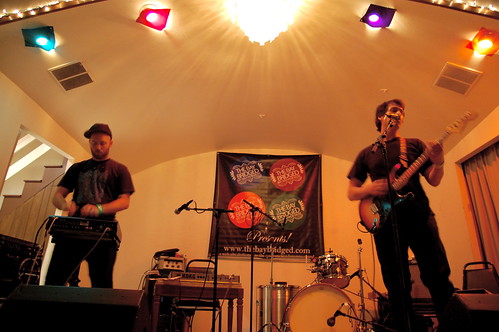
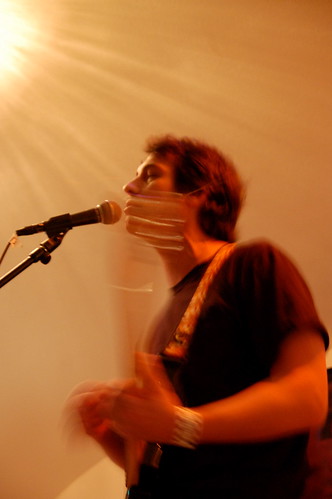
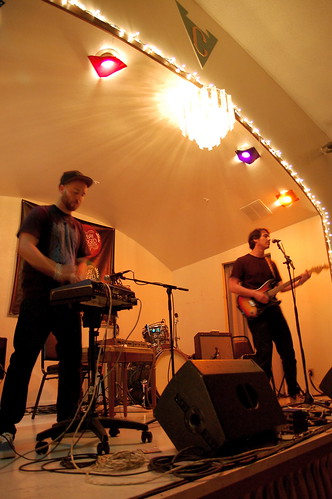
Exrays Played The Verdi Club: Pictures, Video, Interview

Exray's, a San Francisco duo, opened The Bay Bridged Benefit Concert on July 23rd also featuring Man/Miracle, John Vanderslice, and Thao Nguyen. Exray's music is an intriguing combination of inventive songwriting and beat-heavy sound collage. We caught up with members Jon Bernson and Michael Falsetto-Mapp after their set to talk about their process, in and out of the studio. Check out their song "Everything Goes," featured on In A Cloud: New Sounds from San Francisco, a comp with other noteworthy SF bands.

HAD: You guys come from different scenes, Michael as a DJ/ producer, predominantly involved with Hip-Hop. Jon, you've been a songwriter for quite awhile. How does that influence your collaboration as Exray's and bring different influences to your music?

M: Right now some of my influences are J Dilla, Flying Lotus, Mike Slott, and Broadcast. But growing up my Mom and Dad were really into Soul and Jazz: Al Green, James Brown, Herbie Hancock, but also stuff like Talking Heads, Kraftwerk and The Art of Noise. I didn't grow up listening to a specific genre. My mom used to teach dance classes and she would play Prince, Michael Jackson and all types of dance music. As a DJ, I look for songs I like, it doesn't really matter what genre. When I met Jon, he slipped me one of his CDs and I really got into the songwriting, the way he wove together songs and stories. He found a way to tell the story of a fictional place, make it feel real, and at the same time, write about different times in history.

J: For me, lyrical ideas can come from anywhere, past present, future, but I feel like an insect when it comes to musical inspiration. What affects me most comes from my immediate environment; Michael and the other people I create with. Approaching a blank canvas with another person and figuring out how to go forward is what opens me to new ideas. I don't want to come off like I'm immune to the work of famous artists, because that's not the case at all, but my antenna react most strongly to what's right next to me.

HAD: You've said that a lot of your music has been influenced by life on 24th street in San Francisco's Mission District. It's clear that in recent years, the Mission has been gentrified. Are you providing commentary on this? What themes are you exploring in your music?

J: We have hours of recordings taken right outside my door. I've lived in the same place at 24th and Bryant for quite sometime. When we first moved in, Michael DJed our first party and some fights broke out after a gang showed up.

M: They were pissing in his plants.

J: The neighborhood was a lot more wild. I feared it and loved it. And up until the last five years, it had this real night and day kind of vibe. During the day, all Latino families with strollers and laundry baskets, and at night, gangs, homeless people and hospital outpatients. Whatever I write about in the future, I'll always connect to the Mission material because it represents an unforgettable time and place.


HAD: For a duo, you guys have a strong dynamic range. Can you tell us about your sound layering process both live and when making records?

M: Our recorded songs are pretty layered, and for our live show we've broken it down to the key elements. When we started out, I was using a program for DJs called Serato, so it was all our music, but it wasn't 100% live. I would do melodic scratching, trick-mixing, essentially using the turntable as an instrument. As Exray's, we wanted to step with a different show. All live, using no drum loops or pre-recorded material.

HAD: So what do you play? Because a lot of people at the show were asking. What equipment are you using?

M: It's an Akai MPC 2000XL. The acronym stands for: 'MIDI Production Center'. It's basically a tool that allows you to sample sounds, then chop them up and assign them to pads. Then you play the pads with your fingers, like an instrument. Most musicians who have them use it in the studio to multi-track. Most hip-hop is made on some kind of drum machine, or a computer program that has functions similar to a drum machine. But it’s the same concept. You have a machine that enables you to trigger sounds and record the patterns your playing.

J: Yeah, most people use it as a studio tool, not for shows, but we got to a point where we realized it would be perfect for our live set.

M: This dope producer Exile, from LA, is doing it. He’s definitely been a influence for me to do everything live, as well as Jel from Subtle and Themselves.

J: We have a much more organic chemistry now. The tempo can speed up and slow down according to what the song or the moment demands, whereas before with Michael on turntables, we were pretty much locked into a particular tempo. We put a lot of attention into the sounds we make, so another thing we like about the MPC is that Michael can play like 10 custom drum kits in the same show. He gets on one and when the song is over, he moves over and gets on a different drum set.

HAD: Are you bringing 10 guitars with you too?

J: For now I'm trying to bring variety to the set by writing different types of songs, in different styles, lyrics, and ways of using my voice. I want Exray's to begin with the most direct arrangements we can come up with, and focus on bringing the songs to life as immediately as we can. The records focus more on our sound aesthetic and a type of expression that can only happen in the studio. The more I see and play live shows, the more I identify with the physical experience that gets transferred from the people onstage to the audience.

M: We want the to songs provide a strong foundation for the live show, but aren't interested in replicating our records.

J: You know, like holding ourselves hostage in our own house.

M: That's not our goal when we play live. Bringing energy and intensity to the music is most important to us.

J: On our records, we try to make the most of the studio environment. It's something we've devoted ourselves to for awhile now. We haven't played a live show in two years, but we haven't been idle. We've spent hours and hours recording, learning how to use the studio as an instrument, and trying to make that instrument our own.

HAD: On these anticipated records you have coming out, we heard that you collaborated with some pretty diverse artists: Nate Query (Decemberists), Tim Cohen (the Fresh & Onlys),Warren Huegel (Jonas Reinhardt), Dominic Cramp (Evangelista) and Jason Kick (Maus Haus). As a duo do you feel like it's a lot easier to expand your palette and work with other artists?

J: Honestly, the Verdi club was our first real show as Exray's, so we see the live act as an unwritten book. So far, it feels great to play as a duo. At this show, we were able to collaborate with Jason from Maus Haus. We rehearsed with Jason as much as it felt natural and that ended up being two songs. He was great, but we might never play a show with him again, or maybe he'll play a whole set with us sometime? It feels good to have that flexibility. Another thing is that we were packing up our stuff to come to the gig and when we were done, we looked down and all our gear could have fit on a motorcycle. We were ready for the road. Simplicity gives room to roam.

HAD: You guys do a lot of sampling. What are some of your favorite found sounds? Sounds you like in everyday life. Things in your environment that inspire you?

J: Audio illusions, sounds that confuse or challenge your mind to study them in order to figure out what they are. Acousmatic sounds, sounds from concealed sources.

M: We're both into that concept. John Cage and Musique Concrete are influences of ours, especially in the studio.

J: Pierre Shaeffer and Chance Music.

M: Beautiful accidents. We take a lot of inspiration from them when we're recording. A lot of times we're sampling ourselves and rehashing it somehow. Looking for moments that could never be repeated.

HAD: When can our readers get wind of you in NYC? Do you have any tours in the works?

J: We plan to be there in October, when our EP comes out on Howells Transmitter.

HAD: We're looking forward to it!

Interview and Video by Amie Gutierrez
Photos By Sarah Klinger


Thursday, July 15, 2010

Glenn Kotche of On Fillmore: The HAD Interview

As previously mentioned, Glenn Kotche and Darin Gray will be bringing their two-man act On Fillmore to Le Poisson Rouge tonight as part of a small East Coast tour. As they drove out for the shows, Glenn and Darin were kind enough to give us a call from the road and bring us up to date on what to expect from the band, as well as some insights on where they're going with their distinctive sound. With Darin backing him up from the driver's seat, this is our conversation with Glenn. Enjoy!


Hippies Are Dead: So I know that you and Darin met through Jim O’Rourke, your collaboration. And I was wondering about when you guys go into the studio, a lot of the compositions seem to have an atmospheric feel to them and I was wondering how the creative process works compositionally for On Fillmore. Do you guys spend a lot of time experimenting and grabbing the pieces you like best, or do you come in with compositions already scored, or...how does that work?

Glenn Kotche: Kind of a bunch of different ways, but I guess we usually come up with ideas on our own, you know little melody snippets, things like that. Generally we’ll have an idea of what we want to do with the record before we get into it, and then we’ll get into the studio and work on ideas and arrangements and form and other parts. It’s usually just trial and error, we’ll use different field recordings we made, or on this last record we made our own field recordings in the studio as well. You know, different combinations of sounds. We go through a lot of different options and see what resonates with us, and that’s how we kind of form it. But the reality of living apart in two different cities, and my touring schedule, and Darin’s schedule, we don’t get a whole lot of time to just get together and work out ideas, so that’s why maybe some of the initial preparation’s done separately, and then we come together.

HAD: So when you do that, if one of you comes to the table with an idea, do you build out the parts and arrangements from there?

GK: Yeah....

HAD: Yeah?

GK: Sorry, we’re in a van, we’re kind of lost, I’m just trying to help. Okay, no, Darin’s got it now. Yeah, that’s basically how it works: we’ll flesh it out. I guess we’re both a little hesitant of getting anything a little too fully formed on our own. Because it is a duo, and we definitely both chime in on every decision that happens, you know, we try and bring things in a little rawer state. Even if it’s a song, there are some examples on the last record, where even if Darin already had the melody and chords written, I’d come in and suggest different field recordings and we’d choose it that way, or sometimes it’s the opposite. We basically try to collaborate on every aspect of it.

HAD: I was wondering about the field recordings: there’s a lot of bird noises and animal noises on the record, but there’s also a lot of human noises. Grunts, and coughs, and that sort of thing. When you add those to the composition, do you feel like you have an academic message behind it, or is it more of an aesthetic noise based addition to the piece? Do you see it as being noise, or adding structure, or what do those additions mean to you?

GK: Those are all really great questions, and I think one way to answer it would be that we think in terms of place. The way that it’s composed, we’re trying to create places with with music. That’s kind of the idea behind this band from the beginning. Even the name, On Fillmore, it’s a place more than a thing. And the idea of us living in different cities, our past records have dealt with that, and the distance between us. This last record, because we had some time off, we basically with Extended Vacation wanted to create these sort of mystery places, that maybe feel a little familiar, but then also you can’t put your finger on what they are. Some of those elements, some of the elements you’re talking about, and field recordings, some of it is Darin, he just makes sounds when he’s playing bass. You’ll hear his actual vocal grunts, and others are me recording, there was this church group meeting going on at a hotel I stayed at, and just stuck the recorder next to the door and recorded them through the wall. They were having conversations, and laughter, and just sort of all these elements that seem either....we decide the element works when it makes us a little puzzled. When it seems something comforting, but at the same time opens a whole new set of questions. “What is this? I think I’m getting it, but at the same time, this feels comfortable, but I’m kind of afraid at the same time.” I know this all seems a little ambiguous the way I’m explaining it, but I think that’s when we know something’s right. It’s not, “Oh! We need this and this and this”, and it’s premeditated, that we want, you know, a dog snoring on the record, or bird calls. It’s just that, these are the elements that really help create a sense of place that we’re trying to create for the listener. Essentially, as lame as it sounds, for them to take a journey with us, and with Extended Vacation, it was basically “Here’s a tour of these imaginary places we’ve been since you were with us last”.

HAD: It’s interesting that you should say that, in terms of ambiguity and creating a sense of place. There was one interview I read where the interviewer was saying they had used the record to decorate their Christmas tree to. That was the sense of place for them, but for me listening to the record it was a totally different place, so I guess it accomplishes that goal. In terms of that sense of place, it’s kind of an interesting contrast how the record has this human element where you can hear instruments playing, and grunts, and the human side of it. Do you think that when you were in the studio recording, you know, today so many recordings are so clean and sterile, and very much like “Let’s get the recording perfect”. What kind of recording setup do you guys use? Because it feels very organic.

GK: Exactly. You nailed it - that’s one of the principal things of this band. We don’t want anything on the records that sounds like it’s store bought, if that makes sense. The percussion, or, we’ll both just prepare different things, or combine different instruments in different ways to make new sounds out of them. You know, even with vibes, vibes are a very common set of sounds, but maybe we’ll play two sets of vibes with motors on different speeds, and different mallets, and then use the ring from crotalis over it. Just combining different sounds to create something different. To get that organic sound, to get it to sound like, I don’t know, we’re both just big fans of field recordings. It goes back to even all the old Explorer series, and field recordings of indigenous music from Asia and Africa where it’s just a microphone out in a field, and you hear all kinds of sounds along with the music. You hear dancing, you hear cooking, and whatever else. You hear the place, and I think that’s something that inspires us. We try to keep away from anything that’s too clean and obvious. There are bird sounds all over this record, but they’re all manmade. They’re all whistles. We didn’t just download a bunch of bird sounds and pick the one the felt good - that was too obvious. We want them to sound like birds, but have them raise an eyebrow too, if that makes sense. Something that creates this place that’s a little more special and unique.

HAD: When you guys were doing the recordings, how did they fall in terms of live performance versus overdubs? Was everything simultaneous, or how did that work?

GK: Usually anything that’s playing, we’ll play together. If it’s bass and drums, that’s together, or bass and vibes, that’s together. And then, you know, if I’m doubling crotalis with vibes or something, then that’s an overdub. Same thing with field recordings. Some of those are recorded separately and we’ll fly them in the fact. Then in the studio, we’ll just set up a mic, and get on the floor surrounded by stuff and make our own field recordings. And play together, and put that on top. We try to keep it as simple as possible, not get caught up in a lot of different effects and things, we try to do it ourselves. There’s an example of “Daydreaming So Early”, there’s a weird part where the vibes sound all crackly and broken up. Instead of messing with plugins and everything to get this weird distorted vibe sound, Darin went to the back of the Wilco loft, and called me on his cell phone, and I put my cell phone next to the vibes, and then we recorded through his cell phone. You just get that natural static. It gave us this sense of “you’re trying to call this remote place, that’s kind of there, you’re getting a glimpse, but you’re not really...” I don’t know, it creates a little more mystery I think.

HAD: I know you guys said you have pretty hectic schedules, how long did you spend in the studio recording this record?

GK: (To Darin) How long did we spend recording this one? (To HAD) Yeah, it was probably about two weeks time recording this one from start to finish.

HAD: Maybe I’m wrong, not knowing the context, but it seems like for you that you’re playing a more diverse group of instruments than you would be on a Wilco record. Is that accurate, or are they just more up front on this record.

GK: Oh yeah, that’s accurate. On this record there’s two of us playing, and when I make solo records, I play even more! But with a duo, we’re both playing a lot of different instruments. You know, on this record Darin’s playing guitar, and all sorts of percussion, and same with me. With Wilco, there’s six guys, so you have to be a little more refined in terms of what you choose to play.

HAD: When you and Darin play is it a free for all? Do you pick up whatever you want to play, and there’s no boundaries in terms of who’s playing what?

GK: I wouldn’t say there’s any boundaries really, because we resisted it. Part of the reason for our duo is to not have any lead instrument, no guitars. And we resisted that, and yet, guitar ended up on this record. It’s not that we just pick up whatever and go for it. We’re really careful and discuss and really think about the sounds that we choose. If I’m going to play vibes as opposed to glockenspiel or crotalis. It’s not like “oh, I feel like playing vibes”. We really think about which sound is going to blend best with what’s going on, and what we’re trying to convey. So all the sounds were chosen really carefully, but we also know we have a really broad range of what we can choose from.

HAD: So when you were approaching this from the angle of creating and atmosphere and a place, as opposed to laying down melodies - despite the fact that it’s a very ambient and atmospheric record, but there’s also a lot of strong melody going on, particularly with the bass and with the vibes. Do you feel like the compositions, that you restrained melody so that it wouldn’t overwhelm the sense of place?

GK: I think we view melody in a broader sense with this band, in that there’s definitely pitched melodies on bass or pitched tuned percussion, but maybe sometimes we’ll get into a long repetition of those things happening over and over. It’s not just a short, simple melody being repeated over and over, but that now there’s a melody that happens to be in bird calls. The melody in our mind is the evolution of what’s happening in the relationship between a field recording of a fly and random wood block kit,m or whatever the example might be. We’re trying to think of melody as a sequence of events, and opposed to an arrangement of pitches.

HAD: I know you’ve done some New Music stuff with “Clapping Music” and “In C”, how do you as a musician get the listener engaged in these new definitions of music, when maybe they might not be familiar with them?

GK: Haha, well that’s the million dollar question. If I understand correctly, we’re pushing our own definitions of music, and you’re asking how it is that we can get the audience to grasp on to that?

HAD: Well it seems to the Western pop music ear, people are usually pursuing that more conventional definition of melody, with a pitch based hook. I guess a different way of saying it would be how you find yourself engaged in these new definitions. Is it through repeated listening, or training your ear, or an academic pursuit? What is it that engages you in those new definitions of melody?

GK: Well, it’s definitely not a more academic underdstanding, and it’s not even ear training or repetitive listening. It’s more just active listening, instead of passive listening. If you really just open your ears and listen to what’s happening around you, the sound environments that happen. I think if you listen to this music, you’re going to get it if you open your ears and listen to all the sounds, and the combinations of sounds. I understand what you’re saying, that for most people who listen to Western pop music, it might be a little more challenging for them. But you’ve gotta understand, John Cage was one of the most popular people to introduce ideas like this in the 1930’s. That’s a long time ago, and music’s gone a lot of places. For Darin and I, who both really listen to a lot of different types of music, and play a lot of different types of music, what really keeps us engaged is to explore new ways to make music, and make sound combinations that resonate with with us, and have meaning for us. Sometimes that is traditional melody, and sometimes it’s collage. Some of the more challenging aspects of the music, like when you stay on something and repeat it for five minutes, what do expect the audience to do? Well, we’re talking about places here, and we’re talking about going on a little trip together, and sometimes it takes a long time to get to a place. Sometimes we just want to draw the listener in, and bring them with us, so they just have to buckle up and go along on the ride. When you come out on the other side, you get it and you understand it, and you have the payoff and the relief. It’s what feels right for us, and hopefully feels right to other people.

HAD: Along those lines, speaking to different music, what’s some stuff that you and Darin listen to that you feel like people maybe wouldn’t have heard of, and is maybe a little off the beaten path?

GK: I’ll open this question up to Darin too, since he’s sitting next to me. I’ve been in a really intense period of work on commisions, and with Kronos Quartet, a remix project, so any free time I’ve had with music in the past few months has been to meet my own deadlines. Unfortunately, I haven’t been doing a ton of listening for enjoyment.

(Repeats question to Darin)

It’s a great question. I always Mauricio Kagel is one person who jumps into my mind when you’re talking about sound environments, and everything being music, that’d be a great starting point. I listen a lot to the composer John Luther Adams, because his music to me is a lot more about, sometimes about place, but it’s not about a linear sequence of events. It’s more about the moment, and it is it’s own thing. Cage, obviously. Darin mentions we do listen to every day stuff too, but is that what you’re talking about?

HAD: I guess it goes both ways: the every day can inspire the avant garde, and vice versa, so whatever you think suits that definition.

GK: Well Darin just mentioned Levon Helm, I saw him play last week. Bill Fay, J Dilla, we just listened to Bill Dixon, Milford Graves, there’s just so many. Darin said he’s been listening to a lot of Fred Anderson, who just passed a few weeks ago. It goes across the board, both of us have played a lot of music with Jim O’Rourke, and I always come back to that. Anything he does is pretty inspiring to both of us.

HAD: One thing that I’ve been wondering about, is something you mentioned in the commentary track of “I Am Trying to Break Your Heart”, and it caught my ear....

GK: (Laughing) I’ve never actually listened to that, so you may be throwing me a curve ball here...

HAD: No, no, not a curve ball! It’s more of a point of context for a question about you and Darin. In the scene with “I’m Always In Love”, you mention in the commentary that it’s the first day you ever played with Wilco. Given that, in a broader sense, how do feel about the role of spontaneity in performance? That idea that the “first take is the best take”. When you and Darin were in the studio recording this record, especially given how brief the recording was, was it a feeling of a lot of rehearsal culminating in a final recording, or just let’s give it a go, and see what’s there? How much of the performance was intuition versus calculated?

GK: Almost all of it was intuition. Where you say was it well rehearsed, or should we just lay it down and see what happens, we had an idea of what we want the record to be about. But once we get the basic melody or rhythm down, we don’t spend a ton of time doing that. We’re not about perfection. We’re about getting something has some soul and some ass to it. You know, these tunes groove to us. As long as we get something that feels right or wrong. After that it’s all spontaneous, really. It’s just ideas, like “What if we do this?”, or “Let’s try this!”, and if something falls over in a take, or there’s sirens outside, or coughs in the middle of a take, usually it’s like: “that happened in the right spot, let’s keep that”. In the live shows, it’s something that we’re doing more now than we ever used to. Before we used to represent our music and play it. Now, for us, it’s definitely about trying to go somewhere else with the performace. We’re going to play the melodies and harmonies that are on the tunes, but there’s a lot of room for interaction between us and the audience, and let the audience into the performance. Instead of say, just performing our music for the audience. We want to create an event, and a place, and a time-place at the show, if that makes any sense. We want to draw the audience in, instead of just presenting something.

HAD: Along those lines, I know you’ve recently scored some of the other stuff you’ve worked on. Did you guys have any scores for On Fillmore?

GK: No scores. Sometimes Darin will have a melody on guitar, and I’ll have to write it out in order to learn it on vibes, and sometimes we’ll discuss parts, but no, no scores whatsoever.

HAD: I know here in New York there was an exhibition of some Xenakis scores, and a bunch of his scores are very abstract. There’s nothing on the score involving notes, they’re far more just drawings describing the feeling of a piece. Have either of you ever gotten into that kind of alternative scoring of a piece?

GK: I haven’t dealt into graphic scores much, I’m sure I made some when I was younger, but not recently. Darin says a little bit, but if we had a scoring method for this, it’d be more like an idea for a place, so the score would be a place that we descrivbe to each other. Then we make how it sounds, if that makes sense. So it’s more verbal, about adjectives and feelings and about what you feel like when you’re in this place, and what it feels like, and what you went through getting to that place. And then we try to create that experience. I guess that’s a score...it might be more of a guideline or a synopsis. I don’t know what you’d call it. It’s more something you’d talk about and a vision of what we want it to be like.

HAD: Well, I guess that place will be Le Poisson Rouge on Thursday, so we’ll get to see it!

GK: Yeah! Last time I was there I actually saw the Xenakis string quartets, and it’s funny you brought him up, because that’s someone we both listen to a hell of a lot. But yeah, Thursday will definitely be a good time!

HAD: See you there!

On Fillmore play Le Poisson Rouge tonight at 7, Rachel Grimes opens.

Friday, June 11, 2010

Jeff Tweedy Produces New Record From Mavis Staples

Picture by Spencer Tweedy, hoisted from his excellent blog

Leave it to Jeff Tweedy to take all of his rock and roll cred and retroactively apply it to a fantastic vocalist that trumps him in experience by more than a few decades. Put differently: Tweedy has just produced a record, entitled You Are Not Alone, for R&B legend Mavis Staples.

After reading this fantastic interview over at Pitchfork, we're more than a little excited about the record. Not only was it recorded in Wilco's loft with the Wilco gang present and accounted for, but it contains new compositions from Tweedy as well. In short, it should be a very, very, fun record - and sound great to boot!

While we have yet to hear any material from the album, we will say this: we're waiting with bated breath. Tweedy and Co. have been producing some great material as of late, but in some ways have drifted a bit from Wilco's country roots. It'll be great to hear Tweedy at work with an artist who's truly a part of the foundation of American music.

Tuesday, September 15, 2009

Kings Of Convenience: The HAD Interview

Last week we were psyched to get to catch a rare performance by Norway's Kings Of Convenience. As such, it was even more exciting to learn that we were going to get a chance to sit down with Erlend Øye, one half of the dynamic duo. We met Erlend at EMI's headquarters in New York where, despite being a bit under the weather, he was kind enough to join us in a discussion about songwriting, capitalism, recording and impromptu In N Out performance. We hope you enjoy.

HAD: How's your day going?

EØ: It's good but...

HAD: Yeah.

EØ: Yeah. You know, yesterday was the same, and concert, and now...

HAD: The concert sounded great though...

EØ: You were there?

HAD: Yeah, we were there last night and we really enjoyed it. Nice surprise at the end, too. With Feist.

EØ: Cool, cool.

HAD: We've enjoyed your records from quite a few years back, so.... New York is your only scheduled performance - are you planning on doing any other major cities in support of the record later on?

EØ: Yeah, that would be a proper tour, like in a year, maybe April or something, but we're still not sure if it's going to happen.

HAD: What was the motivation for the sort of impromptu concert here?

EØ: Well, Astralwerks asked about it, and we've been working with these people for a long time. Most record companies in most countries change personalities all the time, but these people have stayed the same. So, you know, we kind of have a special relationship with these people. So they asked, and okay okay, why not? Come over here, do a show, do some promotion, play at the radio. It made sense - the United States is one of our biggest markets.

HAD: So, continuing along those lines, do you feel like in your absence over the past few records, have they been ready there for you to release the record whenever you were ready?

EØ: Yeah, yeah - I mean they've been asking: "What's happening?". So that's good.

HAD: You mentioned last night that you're a big fan of the New York restaurant scene, and that you guys got dinner at Kampuchea. What are some of your other favorite places around town?

EØ: Well, we went to Freeman's, because we stay across the road, that was pretty good. We also went to Cafe Select...

HAD: Did you go to the bar in the back?

EØ: No, is there a bar in the back?

HAD: Yeah, you go through the kitchen where they're preparing food, and it's the room in the back that's two levels and tiny with a bar and waitress. Yeah, it's totally weird.

EØ: So it's open all the time? I didn't really see people walking up... That place had good food, but it was way too loud. That's a big problem for me. I hate music in restaurants. It's okay if it's a cafe or something, but a restaurant? If the food is good, you don't need music.

HAD: In terms of music in general, what records are you listening to right now?

EØ: I don't listen so much to music. You kind of, you're working on making music yourself, and there's so much music during the day, you want to hear silence. But what do I listen to? For example, the song "Tigresa" by Caetano Veloso, a Brazilian singer. And, I like, I was listening to the record of the band The XX - a new band from England.

HAD: How would you characterize them, if you can?

EØ: It's not loud, it sounds a bit like early The Cure.

HAD: So, with the new record you kind of went in this bossanova direction...

EØ: We continued the bossanova direction! I guess that's the thing is like - if I would say one thing about this record that it's "more" than the others, it's that it's more slow songs, even more slow songs. There are the bossanova songs, and the rhythmical songs for sure. Well, I just think there's more of it.

HAD: Do you think that's a result of the natural evolution of your earlier work, or was there some outside influence that pushed you in that direction?

EØ: Well you know, there haven't really been - there was bossanova on the first record. We haven't had so many new influences on the band, honestly. There haven't really been anything that we're like "whoa, this is the new thing". Have there? Well, there's this one song "Rule My World" - that has a bit of a French House inspiration. That's the only new thing.

HAD: One of the things that I've spoken with a lot of people about who are big fans is the Versus record, and we were curious how much ownership you feel of that record as part of the band's catalog, versus how much it's other people's work, really?

EØ: Yeah, that's a good question, exactly - because it's not really us - it is our record, but at the same time - it's not really us. So, I think our fans are much more conscious about this record than we are. I rarely think much about it. It's a great record - it's probably the greatest remix record ever, not that that says very much, but it does work.

HAD: Did you have involvement with choosing the artists who did the remixes and picking those people, or was it more the label who did that?

EØ: No, we were very involved - I think our A&R found three of the artists.

HAD: One of the things about your live show is that it's very tight - you have a lot of interplay, and what we hear on the record is very well represented, live. When you get into the studio, do you go for a live performance, or do you work with multiple tracks? What is your recording and rehearsing style?

EØ: Yeah, this record is, yeah, the most live recorded album we've made. Um, and it's - at the moment that the album is recorded, it also marks the time that we are free to move away from that version. You sort of try to figure out "what is the ultimate, what is the pure version of that song?" - that's what we try to record. But the moment it is recorded, then we're totally free to remix it. But we try not to remix it, you know, we want the recorded version to be mostly substance and no style. "Style" meaning if you would add a long instrumental passage because, live for example you have a long instrumental solo. But when we record, we try to have it very compressed. What you were saying that the version on the record were similar to the live versions, that's something that will probably change. We'll go on a tour for real, because now we can change it totally around, if we want to. Because, the real, the ideal, version is on the record.

HAD: When you're playing live, the steel string you use, is that a D-28?

EØ: Very similar to that, yes.

HAD: Are your guitar choices static, and have they been static over the years, or do you vary the guitars that you play on?

EØ: There is something about if you write a song on a certain guitar, and you play it on another guitar, you could be like: "Huh, it doesn't work on this guitar". So, you kind of get stuck with the guitar you bought, in a way. Naturally, if you had tons of different guitars, you could do tons of different things in the studio, with more variation. But, when you then go on tour, you'll have a problem, because you have to bring all the guitars. Because a lot of them won't work on the one that you bring. So I try to stick to my Martin - almost a D-28, but not quite. I don't know why...

HAD: When you do go into the studio and you're recording, how much, if any, of a relationship do you have with the technical side of the studio? Is that something you get involved in?

EØ: Yeah, I'm actually quite into the technical side. It's something I really learned from my time in The Whitest Boy Alive, where it's very DIY. So I learned a lot there.

HAD: When you're recording, are you doing digital or tape?

EØ: Yeah, we haven't used tape for a long time - we used it on the first record. But I found, it's not so much about the tape as it's about how you use microphones, and what kind of room you're recording in. You hear it much more there than in the tape vs. digital. There is a difference, it's tiny, it's there. But it's - digital is so much easier.

HAD: When you're choosing microphones and rooms, do you have certain go-to microphones, or do you experiment in the studio, or both?

EØ: Well, we have some microphones called Schoeps, kind of cigar mics. They've become our main mics.

HAD: When you record, is it the two of you in a room recording live?

EØ: Yeah. Although two songs are more layered, "Mrs. Cold" is one of them.

HAD: We were talking about "Mrs. Cold" before we got here - specifically about a YouTube clip of you playing it at In N Out two years ago. Aside from the In N Out story, we wanted to know how old are the songs on the record, how long have they been floating around?

EØ: Yeah, I mean, "Mrs. Cold" is kind of a new song, which means that it was written in January 2007, so for us that's pretty new. Yeah, after Brazil and Mexico I was in California in March 2007 driving with my friend Simone. We stopped at In N Out where some people challenged us to an impromptu rap battle. I had my little ukulele with me, as we were at In N Out, and well, I played the song.

HAD: Did you win?

EØ: Heh - well, I guess so! But, to my big surprise, it then like a few days later was on YouTube and also on Pitchfork. Pitchfork posted it, and it was so random. But that's really fun, I really love that with, it's the really good thing about, the new digital age. About everyone sharing consumer content.

HAD: And then another song from the new record, "Riot On An Empty Street", it was said that that was originally a song intended for the album of the same name...

EØ: Yeah, the moment that song didn't make the album, the idea that it was a good album title came up. That song is really old - from 2001. But we had a new recording of it that we felt did it justice.

HAD: There's a page on the web that has an extensive set of all the interviews you've done...

EØ: Yeah, the .org, yeah.

HAD: ...and one of them mentions that you had a desire to live in California. Is that something you still think about?

EØ: Yeah, you know, I have to say I'm kind of over that: I can't drive, you know? You kind of get enough of America. America is very catchy, but not so deep. I find after a while, I really enjoy America, but Europe is the best place. It's the most variety in shortest distance. And it's fun with the different languages and the different cultures. It's really, yeah, there's more to dig. Always more to discover.

HAD: In a lot of documentary films about European bands coming to the states, there's this idea of New York as a mythical mecca of pop culture. Specifically, in both The Clash and U2 documentaries, there are scenes where they enter the scenes and they show the band's jaws drop as they see the city. Did it have that effect for you? Did it have a mythical aspect?

EØ: Still does. New York still is a one of a kind place in the world. In Sao Paolo for example, there's a beautiful old part of town, with beautiful sky scrapers: super dangerous. At night time, kids can't be around there. It's so unique in New York, it's the sort of shopping window of the capitalist idea. Here, capitalism works. The best survives. The small, tiny, independent restaurant, store, survives. You go a little bit outside, it's Burger King, Taco blah blah blah. Chains. That's the bad side of capitalism. At some point it has to continue to grow, and it can only keep growing by crushing the small independents, and the quality gets worse and worse. But New York, yeah, it's the best of capitalism. The biggest argument for capitalism. And amazing diversity, and amazing food.

HAD: How does that carry over to Bergen? Has it penetrated in the same way in Europe?

EØ: In Norway, it's much better overall than the United States. We have free health care, social security, not so many chain restaurants. We don't have so much of these "forgotten areas" of the country, like Detroit for example. But, it's not a big country, so, you know.

HAD: Are you living in Bergen now?

EØ: Yeah.

HAD: We've actually been to Bergen: took the Hurtigruten up all the way to the border of Russia and Finland.

EØ: Yeah! Well, I've never taken the whole trip, but I've taken it little by little.

HAD: When you tour some of the cities up the coast, is that how you get there?

EØ: Yeah, or you travel between them at least. We were at a show and the boat was leaving at one thirty at night. It's like, "Oh, good boat! Nightliner!"

HAD: What do you think when your fans, you were joking last night about people trying to speak Norwegian phrases to you, do you think there's an imbalance with American fans? Do we have less international perspective?

EØ: Well, you know, it depends - it's hard to say "Americans" in one big stroke. I mean, as far as I know only 10% Americans have passports, and in Europe that's like "what?" totally unheard of. So, we travel more, but you have all these Spanish speaking people in your country, so, you know, strange. But I'm not expecting anyone to know anything about Norway. And I just kind of laugh. People think it's so amazing to learn a Norwegian phrase. You know, it gets old! The first time it happened it was cool, but then the fifty-ninth time you're kind of like "Haha, okay, 'Good Morning' in Norwegian...yeah, okay."

HAD: Back to the music a little bit - in terms of songwriting, and how you view your music. There's an anecdote about Lennon and McCartney, how they were two guitars, two voices, and had never really considered the concept of a "lead". Then somebody wanted it for sheet music, and asked what's the "lead" vocal line, and they really didn't know - there were just two of everything. When you write and perform together, do you have that concept of taking the lead?

EØ: Well, that's a really interesting anecdote. I think Lennon and McCartney is a really good way to describe me and Eirik, because that's really how it is. It's kind of clearly different, at the same time, you're not always able to tell who it is. There are clearly separate voices, but not always so easy to see. And, the great thing is really the combination of the two makes for a good band. For sure, there are just two guitars, there are just two voices. We don't really care. One is not supposed to be louder than the other. You're just supposed to choose one that you listen to.

HAD: Is that true for writing as well? Do you collaborate, or do you individually bring songs to the table?

EØ: We're much more collaborative than any other band I know. It used to be much more on the first record, much more collaborative. Now it's more half finished songs being brought in, and then we arrange them together.

HAD: In addition to this record, you also had another record this year with The Whitest Boy Alive in March - how do you find balance between the two? Do you complete one and switch to the other, or are they both going at all times?

EØ: Yeah, they're somehow going at the same time. It's not that difficult to differ between them. Usually the songs with The Whitest Boy Alive we jam together and songs come up. But I like the idea of being in both bands. I have a lot of song ideas which are quite similar and it's good to have these kind of different bands, because it just makes it less similar. The different songs kind of become less similar than they would if there was one band and one output. And also, because The Whitest Boy Alive is...the concerts are very different. People are dancing, it's a party, we play festivals. Kings Of Convenience is different, very quiet.

HAD: You said a lot of the recording you do with Whitest Boy Alive is DIY. How does that work? Do you demo a lot of things, use a four track?

EØ: No no, all the members know how to use computers and proper mixing desks, and proper mics.

HAD: Do you have a preference for a digital recording system?

EØ: We use Logic. It's cheaper than Pro Tools.

HAD: And you get to pick your hardware.

EØ: Yeah, that's true too.

HAD: Well, unfortunately it looks like we're getting to the tail end here. Great talking with you.

EØ: Same - it was fun. Thanks.

Photos by Colin Nederkoorn

Monday, July 20, 2009

David Byrne: New Book, Coming To City Arts And Lectures In September

Amidst a well-heeled group of artists, authors, and thinkers, HAD fave David Byrne will be joining in on the goodness of City Arts and Lectures. The series, whose Fall 2009 lineup was just announced, is consistently one of the best sources of commentary and insight that San Francisco has to offer. Byrne will be joining the lecture series as the first participant, on September 29th.

Byrne will be joining in on the lectures as an advocate of bicycles, and in support of his new book The Bicycle Diaries, which drops in September was well. The book is a close to 300 page account of Byrne's travels on bicycles around the worls, and features a range of black and white photographs divided into chapters by city. As with all of Byrne's published works, we're guessing the presentation is pretty choice.

To anyone who has seen previous Byrne interviews or read his extensive online journal, it should be obvious that he's quite the man of diversified interests and great insight. While we're guessing there won't be any music, we're quite content with a good conversation. Don't miss it.

Tickets are already sold out. (!)

Friday, June 19, 2009

Weekend Entertainment: Wolfgang's Vault Has The Clash, Talking Heads, And Joe Strummer

It's been a little while since we've seen any new material that caught our eye on Wolfgang's Vault, but apparently when it rains, it pours. This weekend the streaming site has shows from The Clash and Talking Heads, as well as a two part interview with Joe Strummer. Yes, tasty indeed.

The Clash show is from The Agora Ballroom in Ohio circa 1979, and as such it has a selection of tracks from the band's first two records. Some of those tracks (especially from the second album) got rarer in later years, so it's nice to catch a live version of some of those tracks. We were psyched to see "Stay Free" on the list.

The Talking Heads set is from a 1977 set at CBGB for King Biscuit Flower Hour. It was recorded prior to the band's debut 77, but also interesting contains their cover of "Take Me To The River" from the second album. If you want raw, early Talking Heads, this is your cup of tea.

Finally, the Joe Strummer interview is made up of two parts, one from 1983 and one from 1984. The focus is largely on the breakup of The Clash, and decidedly absent is the optimistic Joe of the late 90's. It's interesting, to say the least.

All in all, these three serve to underscore why Wolfgang's Vault continues to be filed under "awesome" here at HAD - free, rare, new concerts every week? Too cool.

Stream: The Clash Live At Agora Ballroom
Stream:
Talking Heads Live At CBGB's
Stream:
Joe Strummer Interview

Wednesday, May 20, 2009

Nick Lowe Interviewed By The Believer

If you don't already subscribe to The Believer, we'd like to encourage you to do so. The McSweeney's published monthly periodical is the source of some of the best interviews and essays out there, and it's unique format and content is second to none.

Case in point: this month the magazine features comedian Todd Barry interviewing music icon Nick Lowe. The interview is clever and insightful, and features Lowe's thoughts on touring, music composition and technology. Notably, the fact that he has neither a cell phone or email! Check out the interview here.

Thursday, March 19, 2009

New Jeff Tweedy Interview In GQ

Photo from the HAD Archive

Wilco has gotten very big over the past few years - and we might be inclined to assume that Jeff Tweedy's popping up in GQ is an indicator of that. But there's a catch: see, we remember way back in 1999 when GQ featured Summerteeth as their record of the month. So, suffice it to say, the magazine may have some street cred and legitimate love for the band.

That level of interest is pretty apparent in a new interview that surfaced yesterday. In it, the author asks Tweedy some pretty insightful questions, and gets a decent amount of information on the Seven Worlds Collide project ("a lot of cross pollination"), the upcoming Wilco album ("precise wilderness"), and the Ashes Of American Flags DVD ("the ways this band does and doesn’t fit into certain landscapes"). In a year that is looking to be pretty Wilco-heavy come summertime, we're psyched to get the ball rolling. Head over to GQ and check it out now.

Monday, January 12, 2009

Jay Reatard: Interview, Deerhunter Cover

We mentioned a while back that Matador's fuzz-rocker in residence, Jay Reatard, will be at the Independent on January 25th. The show's been a long time coming, and frankly, we're champing (Yes, champing. Look it up.) at the bit to check out the band in a live setting.

In the meantime, we've been enjoying Reatard's release Matador Singles 2008, and in particular held a certain fascination with his cover of Deerhunter's "Flourescent Grey". The track, from the EP of the same title, is one of Deerhunter's more accessible tracks, so it fits in well with Reatard's fuzzy take on easy to dig pop songs. The rest of the disc is a treat as well: if you don't have it, we highly recommend picking it up.

What's more, while you're enjoying the record you can also hopefully get a bit of insight to just who exactly Jay Reatard is. The Onion AV Club has a great, relatively lengthy interview with the man himself. Check it out now....

Tickets for Jay Reatard at the Independent are on sale now.

mp3: Jay Reatard - Flourescent Grey (Deerhunter cover. YouSendIt, click through)

Sunday, December 7, 2008

Another Side Of Spoon: Interview With Jim Eno

Jim Eno at The Fillmore from the HAD Archive

About 90% of the Spoon interviews we read out there are given by front man extraordinaire Britt Daniel. It's no secret that Daniel's one half of the band's always-there members, the other being producer and drummer Jim Eno. Britt makes no bones about steadily and reliably crediting Eno with having a huge hand in the band's sound. Still, interviews with Jim are a bit tougher to find, so we were psyched to check out this interview over at Culture Snob. Eno gives some great insights into the band's recording process and production, including the revelation that Britt Daniel plays much of the band's non-drum percussion and is an "amazing tambourine player". What's more, it features audio of the interview! Good stuff, people, good stuff.

Interview: Jim Eno Of Spoon

Tuesday, November 18, 2008

Ryan Adams on Ryan Adams: Guardian UK Interview

Picture from the HAD Archive

This one is pretty much a fluff piece, but it's fun, and for those wanting to get inside the always frenetic psyche of Mr. David Ryan Adams it's a little window to his noggin. The Guardian UK gave Adams a go at what appears to be a clever little song-title-based questionaire, and he did his duty. Click here to read his musings on love, life, and everything in between.

Thanks to The Modern Age for the tip.

Thursday, October 9, 2008

Wayne Coyne Lives In a Compound

The New York Times has a nice interview with Wayne Coyne today, in the Home and Garden section no less! It talks a bit about his gradually expanding home "compound" and how he puts it to use for everything from band rehearsals to movie filming. Lips fans may remember the house from 2005's Fearless Freaks documentary, and it seems that since then Coyne has expanded into purchasing the three adjacent homes. Indeed. It's a bit of a puff piece, but it's a fun read, and a great way to start your Thursday morning - enjoy!

Monday, September 29, 2008

See What Jay Bennett's Been Up To

If you're a long time Wilco fan, then you're no doubt pretty familiar with Jay Bennett: Bennett served as guitarist and co-writer for the band for a number of years. What's more, he made quite a name for himself as a bit of a tough number in the Wilco biopic I Am Trying To Break Your Heart. Since then, he's recorded a number of albums of mixed quality - frankly, we feel like the guy has talent, but could use a bit of an editor.

That being said, we're always curious to hear what Bennett's up to. This interview with Glide magazine seems a tad self serving, but it is interesting to hear the latest: reviving his studio, having fun online, and (as always) playing music. Bennett has a new digital-only album on the way called At The Perfumed Air, as well as an EP with frequent collaborator Ed Burch. Check it out and see what you think.

Wednesday, September 24, 2008

Some Interviews You Might Like To Read

Both David Byrne and My Bloody Valentine will be in San Francisco in the coming weeks, so we thought we'd take a minute to pass a couple of interesting interviews your way. Pitchfork has an interview with David Byrne on his latest, Everything That Happens Will Happen Today, and the New York Times has a nice sit down with Kevin Shields about the MBV reunion. Enjoy!

David Byrne is at Davies Symphony Hall October 6th and 7th
My Bloody Valentine are at the Concourse Design Center September 30th

Friday, December 14, 2007

Malkmus Madness

We've already mentioned quite a few times that Stephen Malkmus and the Jicks will be at GAMH next Wednesday for one of two dates on the West coast. (Yes, we can't go. Rub it in, it's fine. Jerks.) However, in the meantime it now appears that some amount of media hype has begun to build for the spring release of Malkmus' new album Real Emotional Trash.

Pitchfork has posted an awesome interview with SM himself, and Matador has put up the first mp3 from the new record. We were actually a bit surprised by the mp3: the mix is surprisingly similar to the soundboard recordings from last winter. It looks like Malkmus' claims that this is a very "live" record are true. So, get ready for that show next Wednesday, and in the meantime....enjoy!

Pitchfork Interview: Stephen Malkmus

mp3: Stephen Malkmus and The Jicks - Baltimore